 | ||
| In this picture, the skin is being removed so the muscles and bone can be seen. |
Thursday, October 20, 2011
Chicken Wing Dissection

Tuesday, October 11, 2011
Lab 10/12/11
Today in class, we did the Diffusion Lab, a lab activity observing how the cell plasma membrane in a cell works. We first make a corn starch mixture with a teaspoon of corn starch and a half a cup of water in a plastic baggie. Then, iodine was added to a beaker with water and the baggie was submerged into the mixture. What was suppose to happen didn't: iodine entering the baggie and tinting the corn starch purple. The starch turned a slight shade of purple on the bottom when more iodine was added, but overall, the lab didn't work as expected.
Monday, May 16, 2011
Class 6-16-11
Today in class, we talked about transverse and longitudinal waves. We also discussed the different types of waves that are used, such as light waves, radio waves, and water waves. We even used a sensor to determine the amount of energy used in each wave we made using a slinky per second. It was also the day when we found out we were having a quiz on waves!
Friday, May 13, 2011
Sixteen Year Old Discovers Cure for Cystic Fibrosis
An article was found on Yahoo! about sixteen year old Marshall Chang discovering a promising cure for cystic fibrosis, which previously didn't have one. Cystic Fibrosis is a genetic mutation which causes difficulty of breathing because there is thick mucus that builds up in the lungs and other parts of the body. Chang had thought that two compounds could be able to fight against the protein that causes the disease. He tested his theory, which came out with astonishing results which met his expectations. Chang's discovery could help others and he could possibly saving lives. Because his young age, he inspires me. We studied genetic mutations like cystic fibrosis in our genetic unit, which has me relate to the article.
Thursday, February 10, 2011
Toothpick Fish Lab

To determine the generations of fish, colored toothpicks were used as alleles and were picked out randomly. There was collected data recording the series of fish alleles picked out. When the yellow fish became extinct because the fish pool was very lush and verdant with seaweed and algae, the population of fish decreased. But not all of the yellow alleles were gone, the yellow alleles could blend in with red alleles to make orange scaled fish. This is called codominance, the blending of two alleles. Since there are still yellow alleles left, it is possible for two fish to have yellow offspring. In the first three generations, the green allele was the most common because it was dominant over the rest of the recessive alleles, which blocks the red and yellow alleles. But when the green fish loses its ability to camouflage after having factory waste dumped into the fish pools, it is eaten and the whole population of green fish is wiped out! The population decreased tremendously, but the yellow fish will probably start increasing again because yellow alleles still exist and there are no more dominant green alleles to block the recessive yellow allele.
If the green fish wiped out first before the yellow fish went extinct, the population of the fish will decrease dramatically fast because most of the fish were green. Also, the green allele is dominant over the rest of the alleles. If the yellow fish didn't lose their ability to camouflage, there will probably be more orange fish in the next generation because there is the same amount of yellow alleles as the red ones, which can be combined in codominance and have orange offspring. If the orange fish went into the "morgue", there will be a loss of red and yellow alleles. If the red fish went extinct, many red alleles would be lost because it is a recessive allele which needs two red alleles to make a red fish. Red fish is able to be part of green fish offspring because green fish could have red alleles. Genetics and ecology come together because you could figure out the probability of some animals and extinction using genetics. I believe ecologists needed to know how to solve a mono-hybrid punnet square in order to study organisms and how they became extinct and if the population will ever increase!
Wednesday, January 26, 2011
Underground Yellowstone Volcano
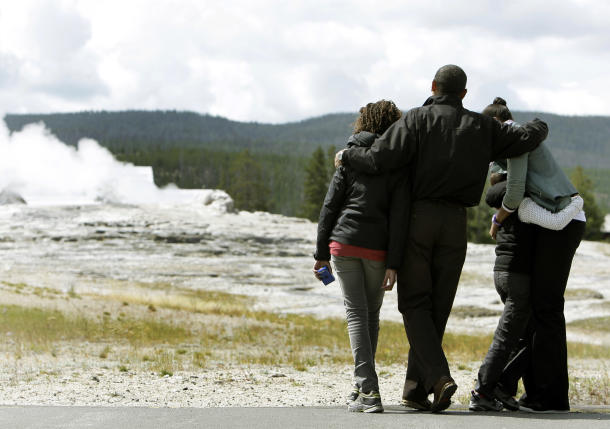
Yahoo Article Link
Yellowstone National Park is a great, beautiful, tourist site where family and friends enjoy spending a few hours. But scientists caution that Yellowstone might explode someday. The Los Angeles size underground volcano gives a few "breaths", causing the ground to rise dramatically. According to National Geographic, the last eruption was "a thousand times more powerful than Mount St. Helen's 1980 eruption." Scientists explain the volcano will erupt soon, and it is estimated the ashes will go up to 25 feet high! Chemicals and modern technology are a few things I enjoy in science, but natural disasters and ecology helps scientists understand how the earth was like without electricity and chemical interruptions. Overall, we learn a lot from natural science.
Tuesday, January 11, 2011
A Green Blob of Gas
From http://news.yahoo.com/s/ap/us_sci_space_blob, it is informed that there is a green blob of gas giving birth to new stars. The stars form at remote parts of the universe, though, where most stars don't normally form. The blob was first discovered in 2007 by Dutch teacher, Hanny's Voorwerp (HAN'-nee's-FOR'-vehrp). NASA released the Hubble telescope photo of the green blob recently on January 10, 2011. When elementary school teacher Hanny van Arkel first saw the blob, he called it a "small blue smudge", but now it's seen as a bright green. The group of stars is approximately 650 million light years away and our own Milky Way Galaxy is about the same size as the blob. Astronauts has visited the blob, and I find it fascinating of our generation finding out new information in the most unknowns places.
Subscribe to:
Posts (Atom)